
Manythings Explored

Having many interests can make life expansive. It can also make it difficult to recognize what deserves our attention and what is helping us avoid something harder. I have a difficult time not finishing a book. Even after I realize I am no longer learning much from it, enjoying it, or particularly interested in what happens next, I feel an obligation to reach the final page. I started it, so I should finish it. That sounds like discipline. Sometimes it is. Other times, it is simply honoring an obligation no one asked me to make. I have been thinking about that distinction because I am interested in a lot of things. That is hardly a revelation. It is part of why I started ManyThings Explored in the first place. I enjoy learning about unfamiliar subjects, starting projects, traveling to new places, developing business ideas, writing, wine, technology, history, and whatever else happens to capture my attention. I believe that range makes my life more interesting. It helps me connect ideas that might otherwise remain separate, and it keeps me from assuming I have everything figured out. But there is an uncomfortable question hiding inside a life built around many interests: When am I following my curiosity, and when am I simply becoming distracted? Not Every Question Needs to Become a Project Curiosity does not always require commitment. Sometimes I hear a name, encounter an unfamiliar idea, or read about a place I have never visited. I look it up, follow a few links, and learn enough to satisfy the question. The entire experience might last ten minutes. That is still worthwhile. Not every interest needs to become a hobby, certification, business, or new part of my identity. Other interests ask for more. Wine became one of those for me. Enjoying wine led to wanting to understand it: how climate affects a grape, why the same varietal expresses itself differently across regions, and what someone trained in tasting notices that a casual drinker may miss. I completed the Court of Master Sommeliers' Level 1 Introductory Sommelier course and examination. I also took a full-day deductive tasting class with Master Sommeliers, learning to examine wine systematically rather than simply deciding whether I liked it. More recently, I took a PreSomm class as a refresher while considering whether to pursue Level 2. I have not taken that next step. That does not make the time I invested unfinished or wasted. I went far beyond satisfying a passing question. I developed knowledge and a way of experiencing wine that I will carry with me whether or not I earn another certification. Curiosity does not announce at the beginning how far it should be followed. We discover that by paying attention along the way. Some questions deserve a few minutes. Some interests deserve years. Others give us what we came for somewhere in between. The Appeal of the New The line between curiosity and distraction becomes harder to see when the original pursuit reaches its least exciting stage. A new interest arrives with energy. There are possibilities to imagine, things to research, supplies to buy, and plans to make. Progress feels quick because almost everything is new. Then comes the middle. The book has to be revised. The business idea needs customers. The certification requires studying what does not come naturally. The trip requires months of physical preparation. The creative project that felt exciting at 5,000 words feels very different at 80,000. That is usually when another interesting idea appears. I have written more than 80,000 words of a novel that I have not finished. Along the way, I became focused on another book, Pretire Before You Retire . The new idea grew out of a conversation with a friend and connected with questions I had already been considering about identity, structure, and what life looks like beyond a career. I followed it, and that manuscript moved much faster than I expected. Did curiosity lead me to Pretire , or did it distract me from the harder work of finishing the novel? The honest answer may be both. The novel had reached a stage where finishing required a different kind of effort than beginning. Pretire arrived with urgency and momentum. Choosing to work on it meant choosing not to work on the novel, at least temporarily. I still plan to return to the novel. I do not consider it abandoned. But 'I plan to return to it' can become a comfortable phrase if it is repeated for too long. That is what makes distraction difficult to recognize. It rarely looks like doing nothing. For people with many interests, distraction can look remarkably productive. What Is the New Interest Helping Me Avoid? I do not think the answer is to become suspicious of every new interest or force myself to complete everything I begin. That would turn curiosity into another rigid system of obligations. Instead, I am trying to ask a more revealing question: Is this new interest moving me toward something meaningful, or is it helping me move away from something difficult? Losing interest is not always a failure of discipline. Sometimes we have learned what we wanted to learn. Sometimes an experience reveals that we liked the idea of the pursuit more than the pursuit itself. Sometimes our priorities genuinely change. Sometimes one curiosity has to wait for another because time is finite. But sometimes we have simply arrived at the point where novelty ends and commitment begins. From the outside, those situations can look identical. In both cases, enthusiasm fades. Progress slows. Another possibility becomes more appealing. The difference is what is happening underneath. If I keep switching interests whenever the work becomes repetitive, uncertain, or uncomfortable, that is probably distraction. If I have stopped receiving value from something and continue only because stopping would make me feel guilty, that may be a failure to trust my own judgment. Finishing is not always discipline, just as stopping is not always quitting. Trading One Curiosity for Another The language of 'finding time' is misleading. Time is not hidden somewhere waiting to be discovered. Pursuing one serious interest almost always requires taking time away from something else. That means curiosity eventually requires choices. I can read about dozens of subjects without reorganizing my life. I cannot pursue mastery in all of them at once. I cannot simultaneously give full attention to a novel, another book, sommelier certification, a new business, weekly essays, travel plans, professional responsibilities, and every other idea that interests me. The limitation is not a shortage of curiosity. It is a shortage of hours. This does not mean I need to pick one lane for the rest of my life. It means I need to recognize the difference between an interest I appreciate and a commitment I am willing to make. It also means accepting that choosing one meaningful pursuit may require placing another on a shelf without treating that decision as a personal failure. Interests change because we change. An experience can matter even if it does not last forever. A project can teach us something even if it never becomes a business. A class can deepen our appreciation even if we do not pursue the next certification. A book can have given us its best ideas before we reach its final page. The goal is not to finish everything we begin. It is to become more honest about why we continue and why we stop. Something to Consider What are you continuing simply because you started it, and what new interest might be helping you avoid the harder work of something that still matters?
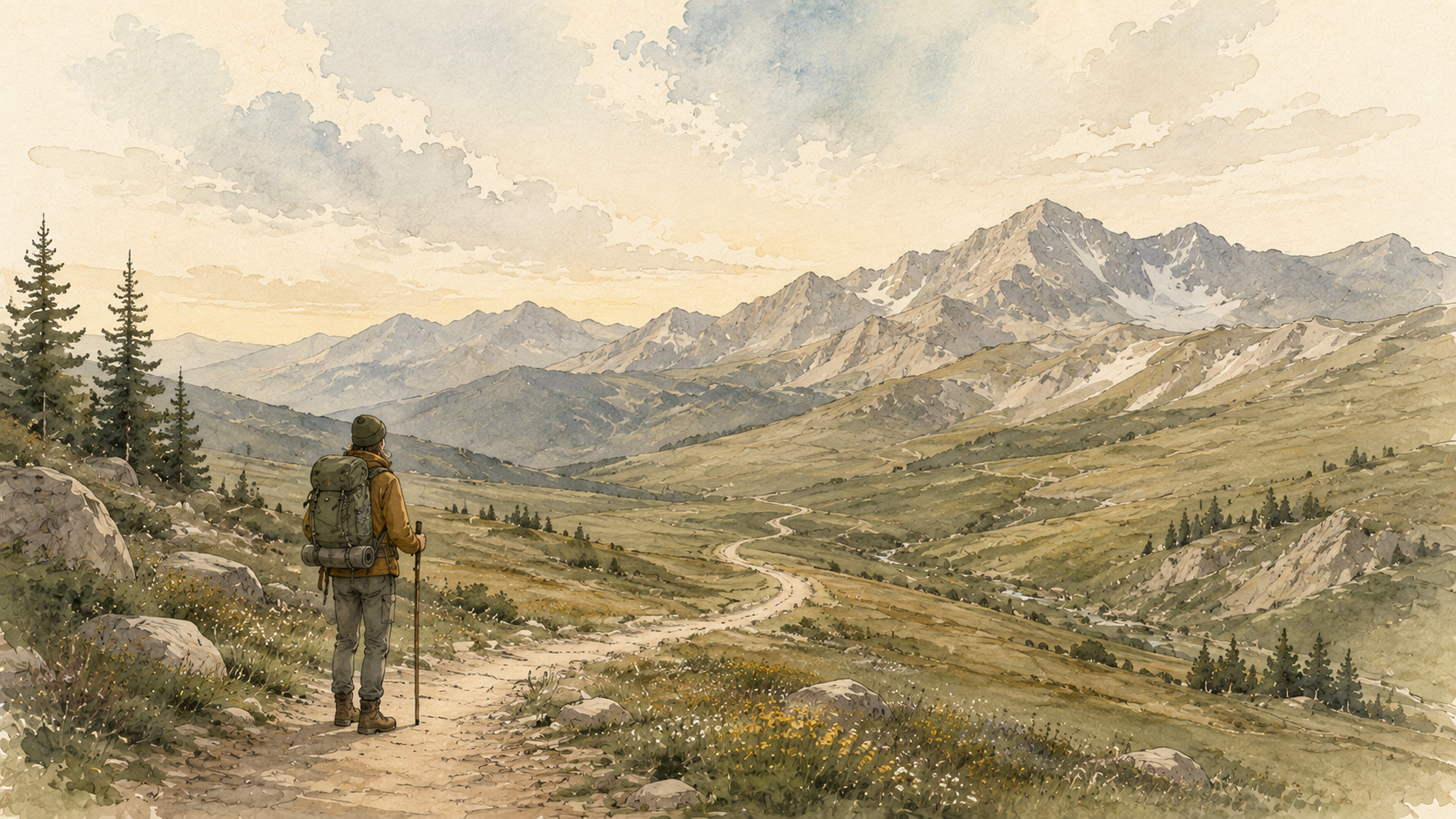
What happens when you commit to something difficult before you know whether you are ready? I have decided that next summer I want to try to hike the Colorado Trail. “Try” is doing a lot of work in that sentence. The Colorado Trail runs nearly 500 miles from Denver to Durango, crossing some of the highest and most beautiful terrain in the country. If everything went according to plan, I would expect to spend roughly 35 days hiking it. That is a long time to walk. It is also almost a year away, which means there is plenty of time for the plan to change. I may get into the training and realize I am not ready. I may modify the route. I may decide to do only part of it. I could start the hike and eventually decide to stop. Those are all legitimate possibilities. But I have also noticed something else: even though the hike itself would not happen until next summer, the adventure has already started. Choosing Something Difficult Enough I have thought about longer trails before. The Appalachian Trail and Pacific Crest Trail are legendary for a reason, but both feel too daunting to me right now. The mileage alone is enormous, and the time required makes them difficult to imagine fitting into my life. Closer to home, I have the Ozark Trail in Missouri. It is still a significant long-distance trail, and parts of it could become useful training, but it presents a different experience. The Colorado Trail somehow sits in an interesting middle ground. It is intimidating. But it also feels possible. That distinction matters. Sometimes a goal needs to be large enough that we cannot casually assume we can do it, but not so large that our brain immediately files it under impossible. Colorado feels like that to me. Long enough to require serious preparation. Difficult enough that I have no business taking it lightly. But still within the range where I can imagine standing in Denver, putting on a pack, and starting south. Imagining that first step is easy. Preparing to deserve it is something else. Preparation Is Part of the Adventure When we talk about adventures, we usually focus on the visible part. The summit. The race. The trip. The finish line. But there can be months of activity before any of that happens. I am already researching packs, tents, sleeping bags, water systems, food, navigation, satellite communication, first aid, clothing, resupply, altitude, weather, and how much weight I really want to carry for hundreds of miles. Then there is training. Walking farther. Carrying weight. Doing consecutive days. Testing equipment when the weather is bad instead of only when it is comfortable. Learning what my feet do after fifteen miles instead of five. Eventually I need to test myself on longer sections of trail, perhaps in the Ozarks, where the elevation is lower but the lessons about sleeping outside, managing food and water, carrying a pack, being alone, and waking up the next morning knowing I have to do it again are very real. None of that is administrative work surrounding the adventure. It is the adventure. The actual Colorado Trail may last around five weeks. Getting ready for it may occupy a year of my life. That changes the math considerably. I Have Done This Backwards Before There is some precedent for this behavior. In 2011, I heard about the Missouri River 340, a kayak race that runs 340 miles across Missouri. I decided I was going to do it. Then I started telling people I was going to do it. At midnight on New Year's Eve, when registration opened, I signed up. About two months later, I bought a kayak. In retrospect, purchasing the basic equipment required to participate might have been a logical step before registering for a 340-mile race. That was apparently not my preferred order. I trained and started the race that year. Fourteen hours and approximately 75 miles later, I was done. I had reached my limit. I did not finish. That could easily have been the end of the story. Instead, I trained more and came back the following year. That time, I completed all 340 miles. I do not tell that story because I assume Colorado will follow the same pattern. I have no idea whether it will. What stayed with me from the MR340 was something different. The first attempt was not wasted because I did not finish. It taught me what the race actually required. There are things research cannot teach you. Eventually you have to enter the river. Or step onto the trail. Telling People Before I Know the Ending I have already started telling friends and family that I want to attempt the Colorado Trail. There is an uncomfortable part of doing that. It would be much easier to keep the idea private until I was completely confident. I could train quietly, make all the plans, and announce the hike only when success seemed likely. That would also remove one of the things I think may help me most. Accountability. If people know what I am working toward, they will ask me about it. How is the training going? Did you test the pack? Have you done any overnight hikes yet? Are you still planning Colorado? Those questions create a little pressure. Not the kind that should push me into doing something unsafe. If the preparation tells me I am not ready, then the smart decision may be to change the plan. But there is a useful difference between changing a goal because you learned something and abandoning it because nobody noticed you stopped working toward it. By telling people now, I am creating a small group of accountability partners without formally asking anyone to become one. I have made the idea slightly harder to quietly forget. That is intentional. Documenting the Attempt I have also been thinking about carrying a GoPro and turning some portion of the experience into an adventure video or documentary. At first that sounds like a separate project. I am beginning to think it may become part of the hike itself. Thirty-five days is a long time to spend inside your own head. Recording pieces of the experience would give me something creative to think about along the way. I could talk about what I expected before a section and what actually happened. Capture the beautiful moments, certainly, but also the bad ones. The day when everything hurts. A storm rolling across a ridge. A campsite that does not work. A mistake. A moment when quitting feels completely reasonable. Or maybe just the strange things you think about after walking alone for eight hours. Documenting the experience would force me to notice it differently. Not simply, “Did I make today's mileage?” But, “What happened today?” Those are different questions. And I suspect they create different memories. Commitment Without Certainty We often treat goals as binary. You did it or you did not. Finished or failed. But that feels incomplete to me. There is another form of commitment that happens much earlier. You choose something difficult enough to take seriously. You tell people about it. You begin preparing. You discover what it demands. Then you keep making decisions based on what you learn. The final decision may still be to go. It might also be to change the plan. That does not make the months beforehand meaningless. If preparing for the Colorado Trail makes me stronger, teaches me more about hiking, gets me outside more often, gives me new experiences, and eventually leads me onto trails I would not otherwise have walked, something valuable has already happened. That is not permission to quit casually. It is permission to learn honestly. The challenge is knowing the difference. The Adventure Has Already Started Next summer, I may be standing at the beginning of the Colorado Trail with a pack on my back. I hope I am. If I get there, though, it will not really be the beginning. The beginning is now. It is reading about something difficult and thinking maybe. It is turning maybe into a plan. It is buying equipment, testing it, training, asking questions, making mistakes, and telling people what I am trying to do before I know how the story ends. The destination matters. The attempt matters too. And maybe one of the best reasons to put something difficult far out on the horizon is not simply that you might eventually reach it. It is that long before you arrive, it begins changing the way you spend your days. Something to Consider What is something difficult you have been thinking about attempting—and what would change if you started preparing for it before you knew whether you could finish?

Trying to explain an idea to someone else may be one of the best ways to discover what you actually think. Earlier this year, I had a conversation with a friend who had recently retired. The conversation stayed with me because it connected to several ideas I had already been thinking about: what happens when work stops providing most of the structure in our lives, how identity shifts, what fills the space that used to be occupied by schedules and responsibilities, and why financial readiness is only one part of preparing for retirement. That conversation did not create the idea from nothing, but it gave the ideas I had been carrying around a clearer shape. I started thinking more deliberately about the period before retirement itself. There is already plenty of good advice about saving, investing, Social Security, healthcare, and determining whether we have enough money to stop working. What interested me was something different. What happens before that? More specifically, what happens when we begin approaching a major transition like retirement while most of the structure in our lives still comes from work? What happens to identity, expectations, relationships, routines, discipline, and the way we think about our time? Eventually I started calling that period Pretire . At first, it was simply a concept I wanted to understand better. I started taking notes, developing ideas, writing about some of my own experiences, and trying to figure out what belonged together. Then the notes started becoming chapters. And somewhat unexpectedly, the idea became a book. Over the past several months, I have been writing Pretire Before You Retire. I haven't talked publicly about it yet, but the manuscript is now nearly finished and working its way toward publication. Writing a book has been an interesting experiment in its own right, but one part of the process has surprised me more than anything else. I thought I understood Pretire before I started writing about it. I didn't. At least not nearly as well as I thought I did. I understood the general idea. I could talk about why it interested me and give examples of what I meant. But trying to explain it clearly enough that another person could follow the idea across an entire book exposed questions I had not yet answered. If Pretire was more than financial preparation, what exactly was it? Which changes mattered most? How did structure, expectations, identity, discipline, and curiosity relate to one another? What belonged in the idea, and what was merely adjacent to it? Those questions did more than help me explain Pretire . They helped me understand it. Over time, separate observations became more defined. Some ideas became central, others disappeared, and connections I had only vaguely sensed became much clearer. Eventually, five themes emerged as the foundation of the book: Structure, Expectations, Identity, Discipline, and Curiosity. I had assumed I was writing down an idea I already understood. Instead, writing was showing me what the idea actually was. Ideas Are Forgiving in Our Heads An idea can remain surprisingly comfortable as long as it stays private. We know the context. We know what we meant. We automatically fill in the missing pieces because the assumptions behind the idea are already familiar to us. That makes it easy to believe something is clearer than it really is. Writing changes that. At some point, I had to explain what I meant by Pretire to someone who was not already living inside my head. If it was more than retirement planning, what exactly was it? If money was not the central subject, what was? Which changes before retirement mattered enough to deserve attention? How did ideas like identity, structure, discipline, expectations, and curiosity relate to one another? Those questions did not simply help me describe the idea. They changed it. Over time, those themes became more defined. Some became central. Others disappeared. Separate thoughts began to form relationships. What initially felt like a collection of observations gradually became a framework. I had assumed I was writing down an idea I already understood. Instead, writing was showing me what the idea actually was. Explanation Raises the Standard There is something demanding about trying to make an idea understandable to another person. You can no longer rely on “you know what I mean.” You have to decide what comes first. You have to identify which details matter and which merely happen to interest you. You have to notice when two ideas that sounded different are actually saying the same thing. Most importantly, you have to confront the places where your thinking is still fuzzy. This is one of the things I have found most interesting about writing a book. Drafting produces words, but revision often produces understanding. A paragraph that does not quite work may be a writing problem, but sometimes it is a thinking problem. The sentence is difficult to write because the idea underneath it has not been resolved yet. Editing becomes more than improving language. It becomes a way of asking harder questions. Is this really what I mean? Does this idea add something, or am I simply repeating an earlier point in a slightly different way? Does this example clarify the argument or distract from it? What am I assuming the reader already understands? The more I revised the book, the more I realized that explaining something is not merely the final stage of thinking. It can be part of the thinking itself. Creativity Is Not Just Generating Ideas We often associate creativity with producing something new. A story. A painting. A business. A product. A song. A book. But I am beginning to think there is another form of creativity that receives less attention: finding a form for something that is still incomplete in our own minds. That process requires choices. What belongs? What does not? What is the simplest way to express this without making it simplistic? What structure allows another person to see the relationship between ideas that I can already see instinctively? Those are creative questions, but they are also intellectual ones. The act of making something forces us to move from possibility toward specificity. As long as an idea remains abstract, many versions can coexist. Once we try to turn it into something real, we have to choose. That can feel restrictive, but it is also clarifying. A Draft Is a Prototype There is a familiar idea in product development: instead of debating every possibility theoretically, build something and see what happens. Create a prototype. It does not need to be finished. In fact, it probably should not be. Its purpose is to make assumptions visible. Once something exists outside our imagination, we can react to it differently. We can see where it breaks. We can notice what is missing. Someone else can ask a question we never considered. The prototype teaches us something that thinking alone could not. I have come to think of writing the same way. A draft is a prototype for an idea. Once the thought exists on a page, it becomes something I can examine rather than simply something I believe. I can move pieces around, remove sections, challenge assumptions, and occasionally realize that the point I thought I was making was not actually the most interesting one. The same principle applies far beyond writing. A business idea becomes clearer when you try to explain why someone would pay for it. A strategy becomes clearer when you have to present it to people who must act on it. A product becomes clearer when someone tries to use it. A framework becomes clearer when someone asks how one part relates to another. Even a personal belief can change when we try to explain it carefully enough that another person understands why we hold it. In each case, creation gives the thinking something to push against. The Useful Question: What Do You Mean? One of the most productive questions another person can ask is also one of the simplest: What do you mean by that? It is a question we often try to answer quickly, but it deserves more respect. We use shorthand constantly, particularly in areas where we have experience. We assume other people share our context. We use words that feel precise because we have used them for years. Then someone asks us to explain them. That is when we find out how much of our understanding is genuine and how much depends on familiarity. Expertise can sometimes make this harder, not easier. The more comfortable we become with a subject, the easier it is to forget which assumptions we stopped questioning years ago. Trying to explain something to a beginner, a reader, a customer, a colleague, or even ourselves can reopen those questions. And sometimes the person asking the basic question is not exposing their lack of understanding. They are exposing ours. Curiosity, Creativity, and the Next Question Curiosity often begins by noticing something that does not quite make sense. Why does this work that way? What would happen if we tried something different? Is there another explanation? Creativity gives those questions form. We write something. Build something. Draw something. Explain something. Test something. Then the thing we created begins asking questions back. That may be the part I underestimated. I thought curiosity led to ideas and creativity helped express them. I now think the relationship is more circular. Curiosity leads us to create, but creation often creates new curiosity. The process of trying to explain Pretire did not simply answer the questions I already had. It produced new ones. Some of those questions strengthened the book. Others changed its structure. A few led me away from ideas I initially thought were important. The result was not just a clearer manuscript. It was clearer thinking. Make the Idea Push Back Not every idea needs to become a book. It does not even need to become something public. But if there is an idea you believe you understand, it may be worth giving it enough form that it can challenge you. Write a few pages about it. Sketch the model. Build the presentation. Explain it to someone who has never heard it before. Create the rough prototype. Do something that forces the idea to exist outside your own head. You may discover that your thinking was already solid. You may also discover contradictions, assumptions, and gaps you could not see while the idea remained abstract. That is not evidence that the idea was bad. It may simply mean the idea is finally becoming real enough to teach you something. Sometimes we think in order to create. Sometimes we have to create in order to think. Something to Consider What idea do you think you understand that might become clearer if you tried to explain, build, or create something from it?
I have never been especially interested in only one thing. For a long time, I assumed that was simply part of my personality. Some people are naturally drawn toward a narrow set of interests, while others seem to move easily between subjects, experiences, ideas, and projects. I have always been in the second group. I can spend one day thinking about artificial intelligence, analytics, and how businesses make decisions, then shift into writing, travel, wine, retirement, history, nature, or a new business idea. I may become interested in how a place developed, why a company makes a particular choice, what makes a wine distinctive, or what happens to a person’s identity when work is no longer at the center of life. Sometimes those interests become projects. Sometimes they remain questions. Occasionally, they lead somewhere I did not expect. What I have come to realize is that curiosity is not simply a collection of interests. It is a way of engaging with life. It is the habit of noticing something and deciding not to move past it too quickly, of asking why it works the way it does, what else it might connect to, and whether there is more to understand than what appears on the surface. That is what this journal is about. The Pressure to Pick a Lane We are often encouraged to choose one thing, develop expertise, stay focused, and become known for something specific. There is good reason for that advice. Focus matters, expertise matters, and few worthwhile things are built without sustained effort. But somewhere along the way, focus can become confused with narrowness. There is a subtle pressure to believe that being serious about one area requires us to ignore everything outside it. We begin defining ourselves by our jobs, our expertise, or the small set of things we already know how to do well. New interests can start to feel impractical, indulgent, or distracting. I do not think that is always true. There is a difference between being scattered and being curious. Being scattered means chasing every new idea without judgment, commitment, or follow-through. Being curious means remaining open enough to notice what deserves a closer look, while still being willing to decide which interests deserve more attention and which do not. Not every interest needs to become a business, a project, or even a lasting pursuit. Some questions are worth following simply because they make us more attentive to the world around us. They may deepen an existing interest, introduce us to a new one, or simply give us a better understanding of something we had previously taken for granted. The Value of Looking Across Boundaries The most interesting ideas often appear between subjects rather than entirely within them. A conversation about artificial intelligence can quickly become a conversation about trust, judgment, organizational behavior, and human responsibility. Travel can become a way of understanding history, culture, geography, food, and why people build communities the way they do. Wine can lead into agriculture, climate, chemistry, tradition, geography, and the strange confidence people sometimes have in their own taste. Writing can reveal how difficult it is to understand what we actually think until we try to put it into words. Retirement can begin as a financial topic and become a much deeper question about identity, purpose, structure, and how we choose to spend our time. An adventure can become less about the activity itself and more about fear, preparation, commitment, or the willingness to be inexperienced again. These connections are often where the value is. Expertise helps us go deeper, but curiosity helps us look sideways. It allows one part of life to inform another and makes it possible to see patterns that may not be obvious when we remain inside a single category. That is one of the reasons I do not want this journal to be limited to only the subjects I know best. I expect to write about data, analytics, artificial intelligence, leadership, sales, and business strategy because those are areas where I have significant experience. But I also want room for travel, wine, writing, aging, retirement, creativity, nature, adventure, and the ideas that emerge when those subjects begin to overlap. The variety is not the problem to solve. It is part of the point. Curiosity as a Practice Curiosity is often described as a personality trait, as though some people simply possess it and others do not. I am beginning to think it is more useful to see curiosity as a practice. It begins with attention. Something catches our interest: a contradiction, an unfamiliar place, a difficult question, a business problem that does not make sense, a conversation that stays with us, or an idea that does not fit neatly with what we already believe. Curiosity begins when we decide that the moment deserves a little more attention. What happens next can take many forms. We might read more, ask someone a better question, visit a place, try an activity, begin a project, or test an assumption. We may discover that our first impression was correct, but just as often we may find that the subject is more complicated than we expected or that our original view was incomplete. Curiosity is not the same as endlessly consuming information. At some point, it has to move from interest to engagement. That may mean taking a class, trying a recipe, tasting an unfamiliar wine, booking a trip, beginning a draft, building a prototype, getting into a kayak, or having a conversation we have been postponing. The action does not need to be dramatic. It only needs to move the question forward. Sometimes the result is a new passion, project, friendship, business, or direction. Other times, the result is simply learning that an idea was more interesting from a distance than it was up close. Both outcomes have value because both replace assumption with experience. The Freedom to Be a Beginner One of the biggest barriers to curiosity is competence. The more experienced we become in one area of life, the less comfortable we may feel entering another where we do not know what we are doing. Professional success often rewards expertise, confidence, and the ability to make decisions quickly. New interests ask us to temporarily surrender some of that. Being a beginner can feel inefficient and exposing. It requires us to ask basic questions, make mistakes, and accept that we may be unimpressive for a while. That becomes harder as we get older and more established, particularly when we have built an identity around being knowledgeable or capable. But there is something valuable in returning to the beginning. Being new at something reminds us that our current identity is not our only identity. We are still capable of learning, changing, and surprising ourselves. Curiosity gives us permission to try something without first proving that we will be good at it or that it will lead to a measurable result. That does not mean every new interest deserves years of effort. It means we should not reject an experience simply because we cannot predict where it will lead or because we are uncomfortable with the idea of starting at the bottom. Some of the most rewarding parts of life begin with not knowing what we are doing. Why This Journal Exists ManyThings Explored is a place for personal thoughts, questions, ideas, experiences, and connections. It is connected to ManyThings Group because both share the same underlying philosophy, but the journal is not intended to explain the company or promote a specific business. It can stand on its own. Some posts will come from areas I know well, including business, data, analytics, artificial intelligence, sales, leadership, strategy, and decision-making. Others will be more personal, touching on identity, aging, retirement, creativity, discipline, relationships, and how we shape a meaningful life. Some will begin with places: travel, history, culture, food, wine, geography, and the observations that occur when we leave familiar surroundings. Others will begin with experiments, such as writing a book, starting a business, learning a skill, testing an idea, or attempting an adventure without knowing exactly what will come from it. Over time, those themes may take shape as four broad areas: Curious Work Curious Living Curious Places Curious Experiments There may also be recurring threads around wine, travel, technology, creativity, retirement, and adventure. The subjects will vary, but the way I approach them should remain recognizable: What caught my attention? Why does it matter? What does it connect to? What changed when I looked closer, and what might be worth carrying forward? The goal is not to make every topic fit into a rigid framework. The categories are simply a way to organize the range of subjects without pretending they are unrelated. Curiosity and Discipline There is a risk in celebrating curiosity without acknowledging its limits. Curiosity can become an excuse for endless research, unfinished projects, or constant movement toward whatever feels newest. Exploration matters, but so do commitment and follow-through. There is a time to investigate and a time to build. There is a time to open possibilities and a time to choose among them. A curious life is not one in which every door remains open forever. It is one in which we continue noticing new doors while becoming more deliberate about which ones we walk through. That balance matters to me. The phrase behind ManyThings Group is: Exploring many things. Building what matters. Those ideas belong together. Exploration without action can become entertainment, while action without exploration can become efficient progress in the wrong direction. Curiosity helps us discover what may matter; discipline helps us do something meaningful with it. I expect that tension to appear often in this journal. How much should we explore before choosing? When does research become avoidance? How do we protect time for new interests without abandoning the commitments that already matter? How do we know when an idea deserves deeper effort and when it is time to let it go? I do not have perfect answers to those questions. I suspect the balance will look different depending on the season of life, the opportunity, and the consequences of being wrong. But I think the questions themselves are worth examining. The Risk of Becoming Finished At some point, curiosity can begin to shrink. Our routines become established, our calendars fill, and our professional identities grow stronger. We rely more heavily on what we already know because it is faster, safer, and more comfortable. We may stop asking basic questions because we do not want to appear uninformed, avoid new experiences because we do not want to be bad at them, and postpone long-standing interests until some imagined future when we expect to have more time, confidence, freedom, or energy. Eventually, it is possible to become very efficient inside a life that no longer surprises us. That is what I want to resist. I do not want to become so certain about who I am that I lose interest in who else I might become. I do not want expertise to replace wonder or routine to quietly become limitation. A curious life does not require constant reinvention. It does not mean abandoning stability, collecting hobbies, or turning every passing interest into a dramatic new direction. It simply means leaving some room for the unexpected and remaining willing to reconsider what we think we know. Curiosity keeps life from becoming entirely predetermined. The Next Interesting Step I do not know exactly where every subject in this journal will lead, and that is part of the point. Some posts may begin with something practical and end somewhere personal. Others may begin with an experience and reveal a broader idea. Some will reach a clear conclusion, while others may leave behind a better question. My hope is that these thoughts do more than document what interests me. I hope they encourage you to notice what still interests you: the thing you have postponed because it seemed unnecessary, the place you keep thinking about, the subject you have always wanted to understand, or the experience you assume you are too old, too busy, or too inexperienced to try. You do not have to turn it into a major project, and you do not have to know where it will lead. You may only need to take the next interesting step. A curious life is not built by having everything figured out. It is built by remaining willing to explore. Something to Consider What is one question, interest, place, or experience you have been waiting for permission to pursue?