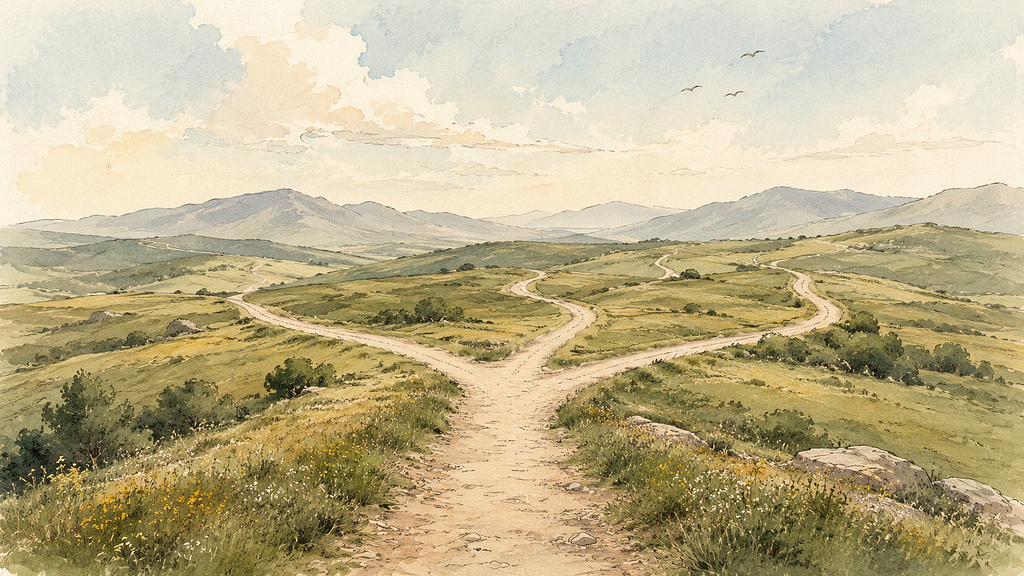
The Adventure Starts Before You Leave
What happens when you commit to something difficult before you know whether you are ready?
I have decided that next summer I want to try to hike the Colorado Trail.
“Try” is doing a lot of work in that sentence.
The Colorado Trail runs nearly 500 miles from Denver to Durango, crossing some of the highest and most beautiful terrain in the country. If everything went according to plan, I would expect to spend roughly 35 days hiking it.
That is a long time to walk.
It is also almost a year away, which means there is plenty of time for the plan to change.
I may get into the training and realize I am not ready. I may modify the route. I may decide to do only part of it. I could start the hike and eventually decide to stop.
Those are all legitimate possibilities.
But I have also noticed something else: even though the hike itself would not happen until next summer, the adventure has already started.
Choosing Something Difficult Enough
I have thought about longer trails before.
The Appalachian Trail and Pacific Crest Trail are legendary for a reason, but both feel too daunting to me right now. The mileage alone is enormous, and the time required makes them difficult to imagine fitting into my life.
Closer to home, I have the Ozark Trail in Missouri. It is still a significant long-distance trail, and parts of it could become useful training, but it presents a different experience. The Colorado Trail somehow sits in an interesting middle ground.
It is intimidating.
But it also feels possible.
That distinction matters.
Sometimes a goal needs to be large enough that we cannot casually assume we can do it, but not so large that our brain immediately files it under impossible.
Colorado feels like that to me.
Long enough to require serious preparation. Difficult enough that I have no business taking it lightly. But still within the range where I can imagine standing in Denver, putting on a pack, and starting south.
Imagining that first step is easy.
Preparing to deserve it is something else.
Preparation Is Part of the Adventure
When we talk about adventures, we usually focus on the visible part.
The summit.
The race.
The trip.
The finish line.
But there can be months of activity before any of that happens.
I am already researching packs, tents, sleeping bags, water systems, food, navigation, satellite communication, first aid, clothing, resupply, altitude, weather, and how much weight I really want to carry for hundreds of miles.
Then there is training.
Walking farther. Carrying weight. Doing consecutive days. Testing equipment when the weather is bad instead of only when it is comfortable. Learning what my feet do after fifteen miles instead of five.
Eventually I need to test myself on longer sections of trail, perhaps in the Ozarks, where the elevation is lower but the lessons about sleeping outside, managing food and water, carrying a pack, being alone, and waking up the next morning knowing I have to do it again are very real.
None of that is administrative work surrounding the adventure.
It is the adventure.
The actual Colorado Trail may last around five weeks.
Getting ready for it may occupy a year of my life.
That changes the math considerably.
I Have Done This Backwards Before
There is some precedent for this behavior.
In 2011, I heard about the Missouri River 340, a kayak race that runs 340 miles across Missouri.
I decided I was going to do it.
Then I started telling people I was going to do it.
At midnight on New Year's Eve, when registration opened, I signed up.
About two months later, I bought a kayak.
In retrospect, purchasing the basic equipment required to participate might have been a logical step before registering for a 340-mile race.
That was apparently not my preferred order.
I trained and started the race that year. Fourteen hours and approximately 75 miles later, I was done.
I had reached my limit.
I did not finish.
That could easily have been the end of the story.
Instead, I trained more and came back the following year.
That time, I completed all 340 miles.
I do not tell that story because I assume Colorado will follow the same pattern. I have no idea whether it will.
What stayed with me from the MR340 was something different.
The first attempt was not wasted because I did not finish.
It taught me what the race actually required.
There are things research cannot teach you.
Eventually you have to enter the river.
Or step onto the trail.
Telling People Before I Know the Ending
I have already started telling friends and family that I want to attempt the Colorado Trail.
There is an uncomfortable part of doing that.
It would be much easier to keep the idea private until I was completely confident. I could train quietly, make all the plans, and announce the hike only when success seemed likely.
That would also remove one of the things I think may help me most.
Accountability.
If people know what I am working toward, they will ask me about it.
How is the training going?
Did you test the pack?
Have you done any overnight hikes yet?
Are you still planning Colorado?
Those questions create a little pressure.
Not the kind that should push me into doing something unsafe. If the preparation tells me I am not ready, then the smart decision may be to change the plan.
But there is a useful difference between changing a goal because you learned something and abandoning it because nobody noticed you stopped working toward it.
By telling people now, I am creating a small group of accountability partners without formally asking anyone to become one.
I have made the idea slightly harder to quietly forget.
That is intentional.
Documenting the Attempt
I have also been thinking about carrying a GoPro and turning some portion of the experience into an adventure video or documentary.
At first that sounds like a separate project.
I am beginning to think it may become part of the hike itself.
Thirty-five days is a long time to spend inside your own head.
Recording pieces of the experience would give me something creative to think about along the way. I could talk about what I expected before a section and what actually happened. Capture the beautiful moments, certainly, but also the bad ones.
The day when everything hurts.
A storm rolling across a ridge.
A campsite that does not work.
A mistake.
A moment when quitting feels completely reasonable.
Or maybe just the strange things you think about after walking alone for eight hours.
Documenting the experience would force me to notice it differently.
Not simply, “Did I make today's mileage?”
But, “What happened today?”
Those are different questions.
And I suspect they create different memories.
Commitment Without Certainty
We often treat goals as binary.
You did it or you did not.
Finished or failed.
But that feels incomplete to me.
There is another form of commitment that happens much earlier.
You choose something difficult enough to take seriously.
You tell people about it.
You begin preparing.
You discover what it demands.
Then you keep making decisions based on what you learn.
The final decision may still be to go.
It might also be to change the plan.
That does not make the months beforehand meaningless.
If preparing for the Colorado Trail makes me stronger, teaches me more about hiking, gets me outside more often, gives me new experiences, and eventually leads me onto trails I would not otherwise have walked, something valuable has already happened.
That is not permission to quit casually.
It is permission to learn honestly.
The challenge is knowing the difference.
The Adventure Has Already Started
Next summer, I may be standing at the beginning of the Colorado Trail with a pack on my back.
I hope I am.
If I get there, though, it will not really be the beginning.
The beginning is now.
It is reading about something difficult and thinking maybe.
It is turning maybe into a plan.
It is buying equipment, testing it, training, asking questions, making mistakes, and telling people what I am trying to do before I know how the story ends.
The destination matters.
The attempt matters too.
And maybe one of the best reasons to put something difficult far out on the horizon is not simply that you might eventually reach it.
It is that long before you arrive, it begins changing the way you spend your days.
Something to Consider
What is something difficult you have been thinking about attempting—and what would change if you started preparing for it before you knew whether you could finish?
ManyThings Explored