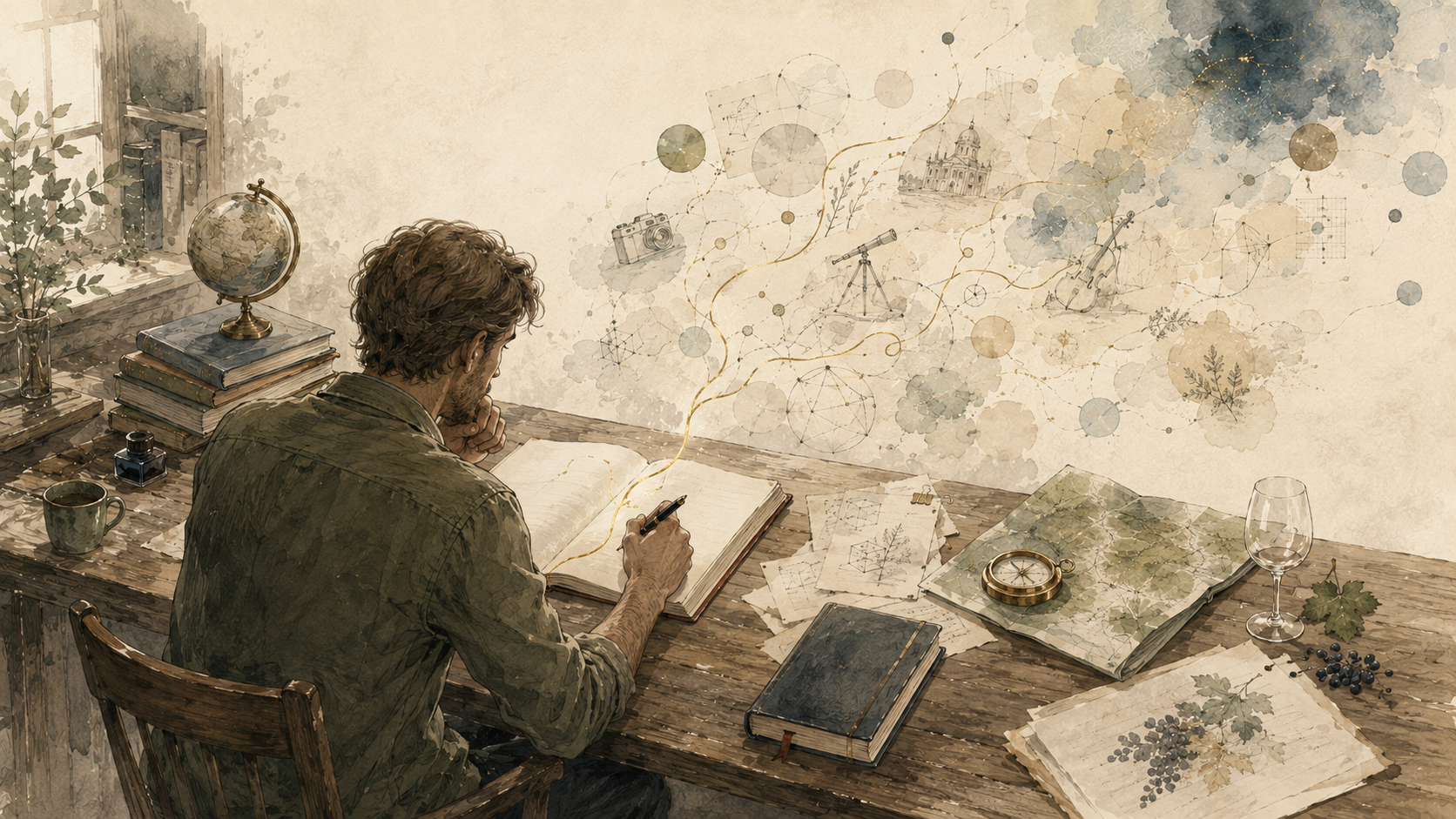
Creating Something Is a Way of Thinking
Trying to explain an idea to someone else may be one of the best ways to discover what you actually think.
Earlier this year, I had a conversation with a friend who had recently retired.
The conversation stayed with me because it connected to several ideas I had already been thinking about: what happens when work stops providing most of the structure in our lives, how identity shifts, what fills the space that used to be occupied by schedules and responsibilities, and why financial readiness is only one part of preparing for retirement.
That conversation did not create the idea from nothing, but it gave the ideas I had been carrying around a clearer shape.
I started thinking more deliberately about the period before retirement itself.
There is already plenty of good advice about saving, investing, Social Security, healthcare, and determining whether we have enough money to stop working. What interested me was something different.
What happens before that?
More specifically, what happens when we begin approaching a major transition like retirement while most of the structure in our lives still comes from work? What happens to identity, expectations, relationships, routines, discipline, and the way we think about our time?
Eventually I started calling that period Pretire.
At first, it was simply a concept I wanted to understand better. I started taking notes, developing ideas, writing about some of my own experiences, and trying to figure out what belonged together.
Then the notes started becoming chapters.
And somewhat unexpectedly, the idea became a book.
Over the past several months, I have been writing Pretire Before You Retire. I haven't talked publicly about it yet, but the manuscript is now nearly finished and working its way toward publication.
Writing a book has been an interesting experiment in its own right, but one part of the process has surprised me more than anything else.
I thought I understood Pretire before I started writing about it.
I didn't. At least not nearly as well as I thought I did.
I understood the general idea. I could talk about why it interested me and give examples of what I meant. But trying to explain it clearly enough that another person could follow the idea across an entire book exposed questions I had not yet answered.
If Pretire was more than financial preparation, what exactly was it? Which changes mattered most? How did structure, expectations, identity, discipline, and curiosity relate to one another? What belonged in the idea, and what was merely adjacent to it?
Those questions did more than help me explain Pretire.
They helped me understand it.
Over time, separate observations became more defined. Some ideas became central, others disappeared, and connections I had only vaguely sensed became much clearer. Eventually, five themes emerged as the foundation of the book: Structure, Expectations, Identity, Discipline, and Curiosity.
I had assumed I was writing down an idea I already understood.
Instead, writing was showing me what the idea actually was.
Ideas Are Forgiving in Our Heads
An idea can remain surprisingly comfortable as long as it stays private.
We know the context. We know what we meant. We automatically fill in the missing pieces because the assumptions behind the idea are already familiar to us.
That makes it easy to believe something is clearer than it really is.
Writing changes that.
At some point, I had to explain what I meant by Pretire to someone who was not already living inside my head. If it was more than retirement planning, what exactly was it? If money was not the central subject, what was? Which changes before retirement mattered enough to deserve attention? How did ideas like identity, structure, discipline, expectations, and curiosity relate to one another?
Those questions did not simply help me describe the idea.
They changed it.
Over time, those themes became more defined. Some became central. Others disappeared. Separate thoughts began to form relationships. What initially felt like a collection of observations gradually became a framework.
I had assumed I was writing down an idea I already understood.
Instead, writing was showing me what the idea actually was.
Explanation Raises the Standard
There is something demanding about trying to make an idea understandable to another person.
You can no longer rely on “you know what I mean.”
You have to decide what comes first. You have to identify which details matter and which merely happen to interest you. You have to notice when two ideas that sounded different are actually saying the same thing.
Most importantly, you have to confront the places where your thinking is still fuzzy.
This is one of the things I have found most interesting about writing a book. Drafting produces words, but revision often produces understanding.
A paragraph that does not quite work may be a writing problem, but sometimes it is a thinking problem. The sentence is difficult to write because the idea underneath it has not been resolved yet.
Editing becomes more than improving language. It becomes a way of asking harder questions.
Is this really what I mean?
Does this idea add something, or am I simply repeating an earlier point in a slightly different way?
Does this example clarify the argument or distract from it?
What am I assuming the reader already understands?
The more I revised the book, the more I realized that explaining something is not merely the final stage of thinking. It can be part of the thinking itself.
Creativity Is Not Just Generating Ideas
We often associate creativity with producing something new.
A story. A painting. A business. A product. A song. A book.
But I am beginning to think there is another form of creativity that receives less attention: finding a form for something that is still incomplete in our own minds.
That process requires choices.
What belongs?
What does not?
What is the simplest way to express this without making it simplistic?
What structure allows another person to see the relationship between ideas that I can already see instinctively?
Those are creative questions, but they are also intellectual ones.
The act of making something forces us to move from possibility toward specificity.
As long as an idea remains abstract, many versions can coexist. Once we try to turn it into something real, we have to choose.
That can feel restrictive, but it is also clarifying.
A Draft Is a Prototype
There is a familiar idea in product development: instead of debating every possibility theoretically, build something and see what happens.
Create a prototype.
It does not need to be finished. In fact, it probably should not be. Its purpose is to make assumptions visible.
Once something exists outside our imagination, we can react to it differently.
We can see where it breaks.
We can notice what is missing.
Someone else can ask a question we never considered.
The prototype teaches us something that thinking alone could not.
I have come to think of writing the same way.
A draft is a prototype for an idea.
Once the thought exists on a page, it becomes something I can examine rather than simply something I believe. I can move pieces around, remove sections, challenge assumptions, and occasionally realize that the point I thought I was making was not actually the most interesting one.
The same principle applies far beyond writing.
A business idea becomes clearer when you try to explain why someone would pay for it.
A strategy becomes clearer when you have to present it to people who must act on it.
A product becomes clearer when someone tries to use it.
A framework becomes clearer when someone asks how one part relates to another.
Even a personal belief can change when we try to explain it carefully enough that another person understands why we hold it.
In each case, creation gives the thinking something to push against.
The Useful Question: What Do You Mean?
One of the most productive questions another person can ask is also one of the simplest:
What do you mean by that?
It is a question we often try to answer quickly, but it deserves more respect.
We use shorthand constantly, particularly in areas where we have experience. We assume other people share our context. We use words that feel precise because we have used them for years.
Then someone asks us to explain them.
That is when we find out how much of our understanding is genuine and how much depends on familiarity.
Expertise can sometimes make this harder, not easier. The more comfortable we become with a subject, the easier it is to forget which assumptions we stopped questioning years ago.
Trying to explain something to a beginner, a reader, a customer, a colleague, or even ourselves can reopen those questions.
And sometimes the person asking the basic question is not exposing their lack of understanding.
They are exposing ours.
Curiosity, Creativity, and the Next Question
Curiosity often begins by noticing something that does not quite make sense.
Why does this work that way?
What would happen if we tried something different?
Is there another explanation?
Creativity gives those questions form.
We write something. Build something. Draw something. Explain something. Test something.
Then the thing we created begins asking questions back.
That may be the part I underestimated.
I thought curiosity led to ideas and creativity helped express them. I now think the relationship is more circular.
Curiosity leads us to create, but creation often creates new curiosity.
The process of trying to explain Pretire did not simply answer the questions I already had. It produced new ones. Some of those questions strengthened the book. Others changed its structure. A few led me away from ideas I initially thought were important.
The result was not just a clearer manuscript.
It was clearer thinking.
Make the Idea Push Back
Not every idea needs to become a book.
It does not even need to become something public.
But if there is an idea you believe you understand, it may be worth giving it enough form that it can challenge you.
Write a few pages about it.
Sketch the model.
Build the presentation.
Explain it to someone who has never heard it before.
Create the rough prototype.
Do something that forces the idea to exist outside your own head.
You may discover that your thinking was already solid.
You may also discover contradictions, assumptions, and gaps you could not see while the idea remained abstract.
That is not evidence that the idea was bad.
It may simply mean the idea is finally becoming real enough to teach you something.
Sometimes we think in order to create.
Sometimes we have to create in order to think.
Something to Consider
What idea do you think you understand that might become clearer if you tried to explain, build, or create something from it?
ManyThings Explored