

Why Adults Need More First Times
Sometimes you have to explore something before you know whether you’re interested.
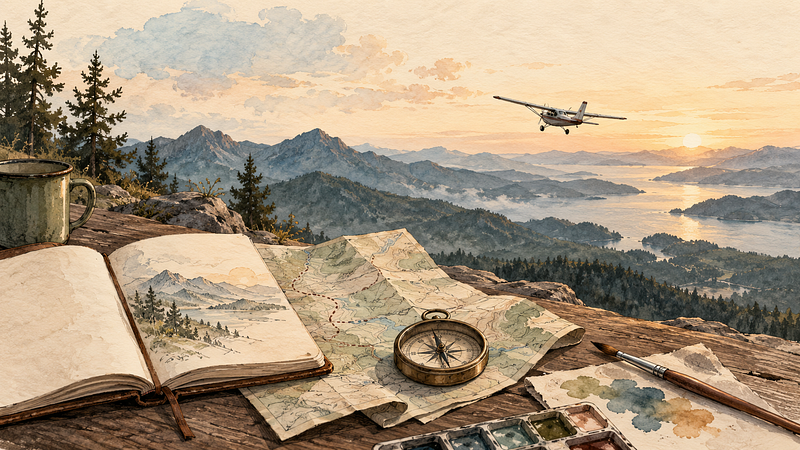
In 2014, my wife bought me an introductory flying lesson.
I have a significant fear of heights.
So while I was curious enough to try it, I had already decided how the story would probably end. I would take the lesson, enjoy the novelty of it, land safely, and check flying an airplane off the list.
One and done.
Instead, I landed, called my wife, and said:
“This is going to be expensive.”
I was hooked.
Over the next two years, I kept flying, kept learning, and eventually earned my private pilot license.
Had you asked me before that first lesson whether I wanted to become a pilot, I probably would have said no. I wasn’t secretly carrying around a lifelong dream of flying. I was afraid of heights. There was plenty of evidence suggesting this wasn’t going to be my thing.
Except I hadn’t actually tried it yet.
And that’s the problem with deciding what interests us before we’ve experienced it.
We Get Very Good at Knowing What We Like
As adults, we become efficient.
We know what kind of food we like. We know what movies we watch. We know where we like to vacation. We know which hobbies sound interesting and which ones don’t.
That efficiency is useful. There is an endless supply of things competing for our time, attention, and money. We can’t try everything.
But I wonder if we sometimes become too good at filtering.
“That doesn’t sound interesting.”
“I don’t like that kind of food.”
“That show got bad reviews.”
“I don’t have time for that.”
“That sounds expensive.”
Maybe all of those things are true. Or maybe we’ve just gotten comfortable with the things we already know we like.
I see this sometimes with theater. My wife and I see a lot of musicals and plays. I’ll read a review or watch a preview and decide something probably isn’t for me.
More often than not, I enjoy it more than I expected.
But that’s part of the point.
You Don’t Have to Like It
About fifteen years ago, we took a trip to Cape San Blas, Florida, with three other families.
I was adamant that we needed to go deep-sea fishing.
About thirty minutes after we left shore, I was seasick.
But I don’t regret going.
More recently, I visited Zion National Park. I’d heard people describe Zion as their favorite national park, so my expectations were high.
It was beautiful.
I was also underwhelmed.
It was crowded, there wasn’t much wildlife, and it simply didn’t connect with me the way some other parks have.
That’s okay too.
Trying new things doesn’t mean discovering that everything is wonderful.
Sometimes you discover a passion that leads to a private pilot license.
Sometimes you discover you never need to go deep-sea fishing again.
The goal isn’t to like everything. It’s to keep finding out.
Curiosity Is a Muscle
Over the last year or so, I’ve spent a lot of time exploring.
I’ve visited national parks I’d never seen before. I watched baby alligators in the Everglades, stood 282 feet below sea level at Badwater Basin, and somehow spotted a wolverine at Mount Rainier.
I spent two weeks traveling through Portugal, from drinking wine in the Douro Valley to exploring a Knights Templar church in Tomar, palaces and castles in Sintra, and the Chapel of Bones in Évora.
I attended my first Formula 1 race.
I rode in a Zoox in Las Vegas, where an eight-minute autonomous ride somehow became a forty-minute tour of places I hadn’t intended to see.
I took a pyrotechnics safety certification class, joined the Missouri Pyrotechnics Association, and eventually synchronized my first fireworks show to music.
I started writing my first nonfiction book.
I started this blog.
Some of those experiences were planned. Others grew out of something else.
That’s what I’ve started to notice.
Curiosity is a muscle that has to be worked.
The more I use it, the stronger it seems to get.
Learning about one thing introduces me to another. Visiting one place makes me curious about somewhere else. Trying something new exposes me to people who know things I don’t know, which gives me more questions to ask.
And momentum builds.
Maybe that’s why I feel more urgency about these things now than I did when I was younger.
It isn’t because I’m approaching some particular birthday or because I’ve suddenly decided life is short.
I’ve realized just how much there is.
There is an effectively endless supply of knowledge, experiences, adventures, places, skills, stories, foods, people, and ideas available to us.
What a wonderful problem to have.
Don’t Wait to Be Interested
We usually think curiosity works in one direction.
Then we explore it.
But I’m increasingly convinced it works the other way too.
Sometimes we have to explore something before it becomes interesting.
That changes the question.
Instead of asking:
“Am I interested in this?”
Maybe occasionally we should ask:
“What might happen if I gave this a chance?”
There are still plenty of things I haven’t done.
I want to get back to my novel and finish it. I want to attempt the Colorado Trail. I’d love to spend several days traveling by dog sled. I want to see the bears at Brooks Falls in Katmai National Park.
And someday, I’d like to sit down with some watercolor paints and figure out what I’m doing.
I might be terrible at it. That’s almost the point.
The goal isn’t to turn every new experience into a passion. Sometimes we’ll discover something we love. Sometimes we’ll confirm that deep-sea fishing really isn’t for us.
Either way, we found out.
And every once in a while, we may land the plane and realize:
“This is going to be expensive.”