

What We Leave Outside the Frame
What we see means more when we understand what surrounds it.
On Friday evening, I went to hear a photographer talk about his work. I expected to come home with a few ideas for taking better pictures. What stayed with me was a photograph of a small fish and a question about how quickly we decide we understand what we are looking at.
The photographer was Noppadol Paothong, who goes by Nap. He is a nature and conservation photographer with the Missouri Department of Conservation, and his work includes more than two decades documenting rare and endangered species and their habitats.
I had several reasons to be there. I became a certified Missouri Master Naturalist in 2025 and belong to the Miramiguoa chapter. Last year, I also volunteered to chair our chapter’s photography contest. We run quarterly themed contests featuring Missouri’s wildlife, plants, landscapes, and other parts of the natural world.
Photography has become an interest of my own over the years. I have gradually improved my equipment and taken pictures in our national parks that I am proud of. I enjoy coming home with an image that preserves something of what it felt like to be there.
So I arrived interested in his craft. As the evening went on, I found myself thinking about conversations, relationships, and the things we miss even when we believe we are paying attention.
Looking and Feeling
Nap began with a quotation from British photojournalist Don McCullin: “ Photography for me is not looking, it’s feeling. “
That idea ran through the photographs he shared. He talked about light, timing, composition, lenses, and perspective, but the recurring question was what the photograph communicated. What would someone feel or understand when they looked at it?
One example made that distinction especially clear.
Nap described photographing a Niangua darter, a small, colorful fish found only in Missouri. He showed how a photograph could capture the fish clearly, revealing its markings and detail. But looking at that image, I could not necessarily tell where it was. It might have been in a creek. It might have been in an aquarium.
Then he showed what happened when he included its surroundings.
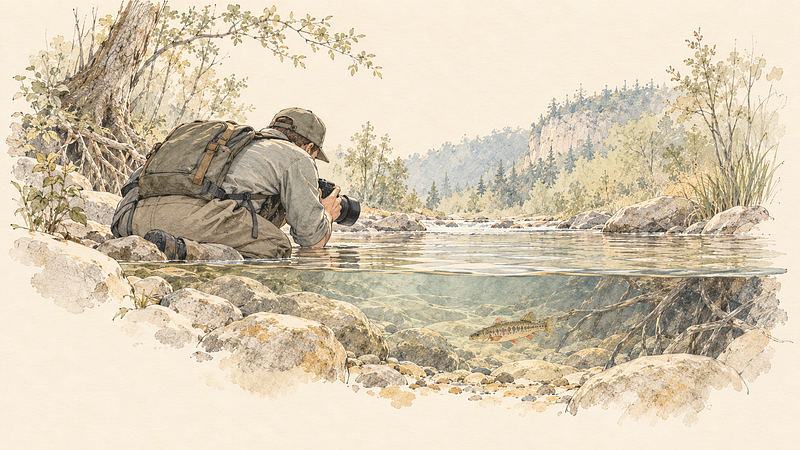
In that photograph, the darter rests among rocks beneath the water. Above the surface, you can see the creek bank and trees. The image holds those two worlds together, revealing the fish within the place it lives.
The surroundings give the photograph a more powerful story. You see a creature with a home, connected to a world that extends beyond its small body.
That was the part that stayed with me. The fish was still the subject, but its environment changed what the image could tell us.
What It Took to See That Story
The photograph also required an approach that was easy to overlook while admiring the finished result.
Nap described working in shallow water, with his elbow pressed into the pebbles, adjusting the focus manually. He had to move carefully. Too much movement could stir up sediment or send the fish darting away. Once he had the fish in focus, he tilted the lens to include the world above the waterline.
Hearing that account changed my appreciation of the image. There was physical discomfort, knowledge of the subject, and considerable care behind a scene that looked quiet and natural.
Nap also talked about the decisive moment. I tend to associate that phrase with action: a bird taking flight or an animal moving through the frame. But he explained that the moment can be much quieter. A slight turn of the head or a shift in the light can change what a photograph communicates, even when the subject has barely moved.
Timing matters, but recognizing the moment depends on understanding what you are watching. Knowing the subject’s behavior helps you anticipate what might happen. Paying attention to the light helps you notice when familiar surroundings begin to look different. The hours of patience he described were filled with observation.
That made me think about timing in our interactions with people. A question can open a conversation when someone is ready to answer it. Asked before they have had a chance to collect their thoughts, the same question might lead nowhere. Sometimes a pause gives someone room to say what they were struggling to express.
I can be quick to fill that pause or prepare my response while someone is still talking. Nap’s approach reminded me that understanding develops while we are paying attention. If I am already moving toward my next question or conclusion, I may miss the moment when something important becomes clear.
The Context Around a Person
We form impressions from what is available to us. We hear a comment, read a message, or watch someone respond in a meeting. Those observations may be accurate. The meaning we assign to them can still be incomplete.
A brief reply can seem dismissive. Hesitation can look like disinterest. Someone’s frustration can appear unreasonable when we know nothing about what happened before we entered the conversation.
The circumstances do not automatically excuse the behavior. They do help us understand it, and that understanding can change how we respond.
This is where the darter photograph became more than a photography lesson for me. The surroundings were essential to the story. With people, we often leave those surroundings unexamined while feeling quite confident about our conclusions.
We usually know the context behind our own behavior. We know when we are tired, distracted, worried, or carrying something we have not explained. Other people receive the visible part. It is worth remembering that we receive only the visible part of their lives, too.
Curiosity can create a little space between noticing something and deciding what it means. It might lead us to ask another question, listen through a pause, or consider whether there is something important we have not yet heard.
Changing Our Position
Another of Nap’s suggestions was to get to eye level with the subject. He also offered a memorable reminder: the best zoom is your legs.
Within photography, those ideas involve physically moving to find a different perspective. I kept thinking about the effort involved. It is easy to remain where we are comfortable and expect the subject to make sense from there.
Understanding another person can require a similar adjustment. What are they trying to accomplish? What pressures are they responding to? What might be obvious from their position that is difficult to see from mine?
Those questions ask more of us than a quick interpretation does. They require us to accept that our first view may be useful without being sufficient.
Last week, I wrote about how curiosity builds momentum, with one interest leading to another. This evening was an example of that in my own life: an interest in nature and photography brought me into a room where I found something else to think about.
It also reminded me that there is depth available within the things we already enjoy. I can keep learning about photography while becoming more thoughtful about how I listen and how I interpret what I encounter.
I still want to take photographs I am proud of. After listening to Nap, I want to give more thought to the story they carry and whether the surroundings help someone understand why the moment mattered.
And when I find myself forming a quick opinion about someone, I hope I remember that small fish in the creek. I may be seeing something clearly while still missing much of the world around it.