

Wine Tastes Better Outside
Sometimes understanding something requires more than knowing what it is. It requires getting closer to the place and people that shaped it.
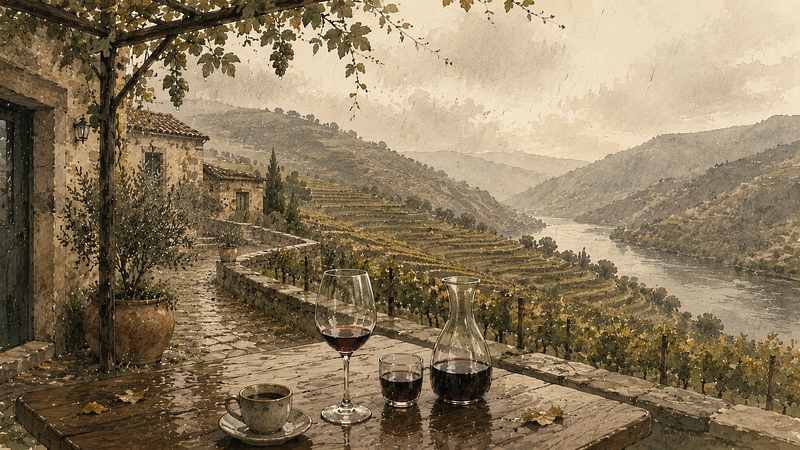
Wine Tastes Better Outside.
I realize that is not a particularly scientific claim. Temperature matters. Glassware matters. How a wine is stored and served matters. There are plenty of variables that probably matter more to the actual chemistry of what is in the glass than whether I happen to be sitting on a patio.
Still, after years of drinking, studying, and generally being interested in wine, I am convinced there is something to it.
Outside, there is more happening.
You notice the temperature of the air and the breeze. You smell whatever is growing around you. You feel the sun, or occasionally the rain. There is a landscape beyond the rim of the glass.
All of it becomes part of the experience.
And wine seems to taste even better when you are drinking it in the place where it was grown.
I have experienced that many times in Napa. One of our favorite wineries is Chimney Rock, where we have had opportunities to walk through the vineyards while tasting wines produced from the different plots around us.
Wine education teaches you about things like soil, sun exposure, elevation and microclimate. You learn that seemingly small differences in geography can affect how grapes ripen and ultimately what ends up in the bottle.
It makes sense intellectually.
Then you stand among the vines with the wine in your hand.
Someone points toward another section of the vineyard and explains that it sits perhaps a hundred feet higher, receives slightly different sunlight, or experiences a somewhat different microclimate. You taste the wines while looking at the places that produced them and begin searching for those differences in the glass.
The idea of terroir suddenly becomes much less abstract.
Your feet are on the soil.
The vines are around you.
The conditions you have studied are no longer facts on a page. They are the place you are standing.
Earlier this year, my wife and I had an experience in Portugal that pushed that idea considerably further.
We spent two weeks traveling around the country, including a few days in the Douro Valley. The Douro is one of those places that is difficult to fully appreciate from photographs. Vineyards climb steep hillsides above the river, carved into terrain that sometimes seems almost unreasonable for agriculture.
Thankfully, we had a driver. The road became increasingly narrow and winding as we climbed toward Quinta de Santa Eufemia, occasionally shrinking to a single lane around a tight corner.
When we arrived, we pulled onto cobblestone paths surrounded by the mixture of an old family property and newer spaces designed to take advantage of the remarkable view.
It was lightly raining.
A bright, sunny day would have been beautiful, but somehow the rain made our arrival better. The Douro is known for its intense heat, yet that afternoon the cool air, misty hills and light rain made the property feel less like somewhere we had arrived to tour and more like somewhere we had been invited inside.
One of the great-granddaughters of Bernardo Rodrigues de Carvalho, whose family has owned the property since 1864, greeted us.
I expected we would begin talking about wine.
Instead, she asked if we would like a coffee.
Absolutely.
She made us each an um café-the small, short, strong espresso common throughout Portugal-and we sat in the tasting room looking across the property.
And for a while, we didn’t taste any wine.
She told us about the history of the property and the land. We talked about her family and ours. We talked about Portugal and about our trip. Nothing felt hurried, and it genuinely seemed as though she was enjoying the conversation as much as we were.
Eventually we got up and walked around the property.
We went into the winemaking facilities and saw the old granite lagares that had been used in producing wine there for generations. They weren’t replicas placed behind ropes to help tell a story. They were part of the story.
I put my hand on the stone.
It is difficult to touch something like that without thinking about the harvests, people, good years and difficult ones that came before you.
She told us grapes had been grown on their land since the late 1700s.
Not the same vines, of course.
But for more than two centuries, that land has been connected to wine.
The vines have changed. The people have changed. The techniques have changed. But the soil and hillsides have continued producing more than grapes. They have accumulated stories, friendships, hardships, celebrations and memories.
At one point during our walk, another woman passed by.
Our host casually mentioned that it was her sister, the winemaker.
She was busy working, so we didn’t stop and have some carefully choreographed conversation with her.
And I liked that.
This wasn’t a showroom.
It was their livelihood, and they were working it.
Eventually we went back upstairs to taste the wines.
We tried several still wines and several Ports. Our host explained them, talked with us for a while longer, and then left us alone to enjoy the wines and the view.
By then, though, we weren’t simply tasting wine.
We were tasting something we understood differently than we had a couple of hours earlier.
Place Is More Than Geography
Wine people talk a lot about place.
There is good reason for that. Climate, soil, elevation, exposure and rainfall matter. Grapes grown in different places taste different, sometimes even when those places are remarkably close together.
But that afternoon in the Douro reminded me that place is more than geography.
Place also contains people.
Seven siblings now collaborate around a family enterprise that began roughly 160 years ago. They inherited something their great-grandfather began, and they are adding their own chapter to it.
That changes how I think about the word place.
A vineyard is soil and slope and climate.
But it is also decisions.
Someone chose what to plant. Someone cared for the vines through difficult seasons. Someone figured out what worked and passed that knowledge along. Someone decided which traditions should remain and which needed to change.
Over enough time, the physical place and the people become difficult to separate.
Maybe that is part of what we taste when wine seems better at the vineyard.
Not literally, perhaps.
But experientially.
The wine has gained context.
Getting Closer Changes What We Understand
There are many ways to learn about something.
You can read about the Douro Valley.
You can study Portuguese wine.
You can memorize grape varieties, production methods and classifications.
You can learn what terroir means and explain why elevation or sun exposure matters.
All of that is useful.
But it is different from driving along the narrow roads, feeling the rain, standing among the vines, touching the old granite equipment, sharing coffee with someone whose family has worked the land for generations, and then drinking the wine while looking out over the hillsides that produced it.
The facts may not change.
What they mean to you does.
I suspect this applies to far more than wine.
Food makes more sense when you understand the culture and geography that created it.
History becomes different when you stand where it happened.
A city becomes more understandable when you stop looking only at its landmarks and begin noticing how people actually live there.
Even people can become easier to understand when we know more about the experiences, places and circumstances that shaped them.
We spend a lot of time trying to understand things after removing them from their context.
Sometimes that is necessary. It allows us to study, compare and analyze.
But something can also be lost in the process.
Getting closer to the source can restore it.
Maybe Wine Really Does Taste Better Outside
I still believe wine tastes better outside.
Maybe some of it is sensory. The air and temperature and smells around us are unquestionably part of how we experience anything.
Maybe some of it is psychological. A beautiful vineyard in Napa or a rainy afternoon overlooking the Douro is difficult competition for drinking the same bottle at the kitchen table.
And I am perfectly comfortable admitting that being on vacation in Portugal probably improved the wine too.
But I think there is something else happening.
By the time we sat down with those wines at Quinta de Santa Eufemia, the glass contained a story we could see.
We knew a little more about the land.
We had touched part of its history.
We had met one of the people carrying that history forward and watched another walk past us on her way to do the actual work of making the wine.
None of that changed what was chemically inside the glass.
It changed our relationship with it.
Perhaps that is the larger lesson I will carry from the experience.
When something interests us, it is useful to ask what it is and how it works.
But occasionally there are better questions.
Where did it come from?
What shaped it?
Who shaped it?
And what might I understand differently if I could get a little closer to the source?
Sometimes understanding requires more information.
Sometimes it requires standing in the rain, drinking a glass of wine in the place where it began.